
Popular articles
Recent discussions on forum
Financing on farms is a huge bottleneck for development; here's how we can fix it.
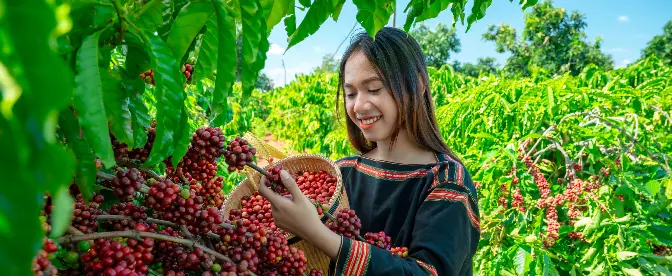


Coffee is a volatile commodity that millions rely on for their livelihoods. This unpredictability in price has far-reaching consequences for coffee farmers, their crops, their communities, and the market as a whole. How can we secure the supply of coffee while ensuring that coffee farmers receive the kind of financing they need?
In this article, we explore how farmers are paid, how this affects their ability to manage their farms and livelihoods, and how we can make the system better for everyone involved.
How are Coffee Farmers Paid?
Buying and selling green coffee is often not as simple as you would think. While farmers incur costs all year round, they are most often paid a few times a year in lump sum amounts as they deliver their harvests. The final product they sell can be green coffee, wet parchment, dry parchment, or cherries. Most farmers cannot afford to hold their stocks, and so a majority is sold during harvest seasons.
Moreover, while coffee farmers and buyers may agree on a price beforehand, the farm gate prices may not always match this amount. Coffee prices are notoriously volatile, and changing economic conditions in the market can alter what farmers actually get paid. On top of this, farm gate prices don't always cover the costs incurred by the farmer for transportation, export fees, etc.
Ultimately, farmers are frequently receiving less than what is paid to traders or processors, meaning they retain less value at the farm.
Why Do Coffee Growers Need Better Access to Finance?
To understand why coffee growers need better financing, first we need to consider the costs they incur in the process of growing, harvesting, processing, transport, and more.
Coffee growers need working capital to purchase farming inputs such as fertilisers, new equipment, machinery maintenance, planting new lots, and investing in better processing and harvesting. Then we must consider the cost of labour, transportation, and general farm maintenance. These are year-round costs which farmers must manage while being constrained by access to capital.
Recouping these costs can take years since coffee harvests are time-consuming and can be unpredictable. Many farmers, especially smallholder farmers, struggle to meet these costs, and many rely on loans to close the gaps. However, many smallholder farmers don't have access to good loans and end up paying high interest rates.
Access to capital gives coffee growers some security to cover immediate costs as well as unforeseen circumstances that would otherwise derail their operations.
How Does Timing Affect Farm Financing?
Sporadic and spaced-out earning schedules means coffee growers have a hard time with both long- and short-term planning. This primarily hits hardest for smallholder farmers but can also affect medium-size farms. Large farms might be able to weather periods of low funds but nonetheless, this still affects their daily operations and ability to plan ahead.
Coffee growers can receive payments in a few ways. They can sell based on the daily C market price, but this kind of spot selling and buying is unreliable and volatile. They can set up a contract with buyers, but this payment can take months to process and reach the farm. Lastly, they can receive advance payments through being part of a cooperative or by having forward contracts.
Most coffee farms around the world are smallholders. For these farms, without advance payments or financing options, they are unable to truly achieve the full potential of their land and crops. Not only are they unable to invest in the development and betterment of their farms, but in many cases they are also unable to maintain a living income, which has far-reaching consequences for their families and communities.
Closing the Finance Gap
The finance gap disproportionately affects small and medium farms, many of which are owned by women and young people. These farms find themselves between a rock and a hard place: too large for microfinance loans and too small for traditional bank loans. Moreover, interest rates are exorbitant, repayment schedules don't account for the yearly payment schedule of coffee trading, and collateral is tough to secure.
This kind of scenario is detrimental to the coffee sector as a whole: farmers are pushed into informal and exploitative trades and loans, younger people and women without land ownership are pushed out of growing coffee, and the overall coffee market shrinks both in quantity and quality.
Closing this gap requires stronger relationships between growers and buyers which enables better contracts and payment schedules, as well as support to access legitimate and non-exploitative loans.
Beyond Finance: Building Trust, Transparency, and Traceability
As we have established, coffee sourcing and trading is complex. Without a strong foundation between growers, traders, and roasters, the risk along the supply chain increases and causes inefficiency, delays, and potentially lower-quality coffee at the end.
Strengthening the relationship between farms and buyers is vital for securing financing, investing in quality on farms, ensuring buyers get the best coffee possible and ensuring the livelihood and well-being of coffee growers.
There are numerous ways to build these long-term, robust relationships:
Long-term contracts are the core of this security. It allows farmers breathing room to plan ahead, enables them to secure better loans and interest rates, and gives them the security they need to continue growing coffee.
A better understanding of on-farm expenses, how farmers manage their operations, and the struggles they face, both logistically and otherwise, helps buyers along the supply chain to build more trust with coffee farmers. Improved trust and transparency benefit everyone and especially the coffee itself. With financial security comes the freedom to experiment, to invest, and to build stronger supply chains.
Sustainability Practices
About the author
Join me in discovering the wonderful world of coffee! As a writer, coffee is my fuel and newfound passion. I love writing about new coffees, sustainability, and coffee culture around the world. I'm always discovering new things about coffee and the industry, which I share with the great community here at Era Of We.
Recent discussions on forum
©2026SEWN Technology Solutions ABAll rights reserved
©2026 SEWN Technology Solutions AB All rights reserved